
Tools Used
- Feedback
- Financial Incentives and Disincentives
- Norm Appeals
- Overcoming Specific Barriers
- Home Visits
- Mass Media
Initiated By
- Alberta Power Limited
Partners
- Natural Resources Canada
- Local retailers
Results
The project had a return on investment (ROI) of 95 percent annually over five years and a pay-back period of one year. Overall demand for power dropped by almost 10 percent over four years, compared to a provincial increase of 17 percent.
 Tip: Click on an image to enlarge it. Click your back button to return to this page. Tip: Click on an image to enlarge it. Click your back button to return to this page.
|
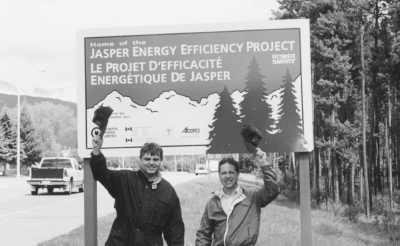
Jasper Energy Efficiency Project (JEEP)
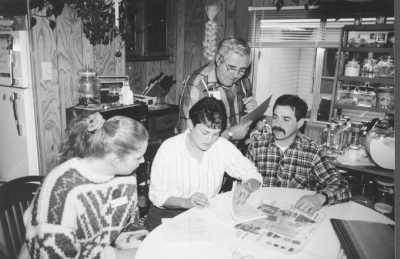
To promote energy conservation, Jasper residents received a one-hour home visit in which conservation strategies and a retrofit incentive program were explained. They were also offered energy efficient products, installation included. The JEEP program won five awards, including two from the International Association of Business Communicators.
Background
Located in Jasper National Park, the town of Jasper is isolated from the electric grid in Alberta. Demand for power in this town of 4,500 residents nearly doubled from 1981 to 1991, primarily due to growth in the commercial and industrial sectors. The town was serviced by a 14 MW natural gas-fired generating station and a 1.3 MW hydroelectric plant; overall capability of the system was nearing capacity.
The residential component of the Jasper Energy Efficiency Project (JEEP) ran through 1991 and 1992. By reducing demand for power, Alberta Power hoped to defer the construction of a new transmission line or the expansion of the existing power plant.
Setting Objectives
JEEP's goals were to reduce demand for electrical energy by 500kW and to enlist support from 75 percent of Jasper's residents.
Getting Informed
A door-to-door residential energy survey was conducted between August 7 and September 27, 1991, to determine the most promising options for reducing power consumption and to identify the types of Power Smart programs which could be successfully implemented. Two Alberta Power employees, both local residents, were hired and trained to conduct the research. They delivered the questionnaire to 911 households, answered questions and invited residents to complete and return the survey in a postage-paid envelope to Alberta Power. Nearly 500 were returned. Survey results suggested that energy savings could be achieved by encouraging residents to use compact fluorescent light bulbs and to heat water with natural gas.
In addition to the survey, a literature review was conducted. The research showed that sales of block heater power saver cords in the Yukon had been impressive, but that most of the cords had either not been installed or had been installed incorrectly - the result of customers having to perform the installation themselves.
Delivering the Program
To guide the project and to provide local input, Alberta Power established a Public Information Committee, made up of representatives from the general public and various groups such as the School District, environmental groups, the Chamber of Commerce, and the Hospital Board. A JEEP office was set up in Alberta Power's existing district office to centralize all customer-related electrical enquiries in one location and to minimize administrative costs.
Public awareness was created as follows:
- The project was launched at a public event covered by provincial media and attended by 300 members of the public. Canada's first Energy Innovators Award was presented to the JEEP program at this event by Natural Resources Canada.
- Promotional items such as pens, hats, T-shirts and key chains bearing the Power Smart logo, were distributed to residents.
- Bill stuffers, brochures and an edition of the Alberta Power Smart Report were distributed.
- Local newspapers provided ongoing coverage of the program in editorial articles. This was a result of Alberta Power's efforts to develop a strong relationship with the media. The newspapers also carried stories about the project and highlighted residents who participated in it (Norm Appeals).
- JEEP's newspaper advertising campaign consisted of two series of advertisements, one featuring lifestyle ads, and the other describing the program and providing instructions on how to book an appointment with a JEEP Team.
- Local people were hired to form the two trained teams of employees (JEEP Teams). Alberta Power felt that it was important to ensure that the employees were familiar with Jasper's residents, as this provided insight into the community and created public credibility. The high level of trust already established between Alberta Power and its customers dispelled any barriers arising from residents' skepticism about the program.
The JEEP Teams went door-to-door explaining, selling and installing the energy saving products. Home visits were used because this was the most effective way of explaining the complex details of the program and securing participation (Home Visits).
JEEP provided financial incentives to induce customers to install energy efficient products in their homes (Financial Incentives and Disincentives). A maximum of 80 percent of the retrofit cost, and up to $450 per kW saved, was covered by the program. The following products were offered:
- Coupons for block heater power saver cords were sold for $7.50 by the JEEP Teams. To ensure that the cords were installed properly, the coupons had to be redeemed at Jasper's service stations, where installation was available. Alberta Power paid the service stations $5 for each cord they installed (Overcoming Specific Barriers).
- A selection of compact fluorescent light bulbs, ranging from 11 to 18 watts, were sold to residents for $3 or $5 each. A limit of eight bulbs per home and five per apartment was set after the first two days of the program, when it became apparent that people were buying large quantities as gifts to people outside of Jasper.
- Up to two indoor and two outdoor lighting timers could be purchased per residence. The indoor timer was sold for $4, and the outdoor one for $9. The JEEP Teams instructed the residents on the operation of the timers, particularly their application to Christmas lighting.
A $400 incentive was offered to residents to convert electric water heaters to natural gas. Initially residents were required to retain their own contractor for the installation. On average, participants were paying approximately $800 with the rebate. This proved to be a barrier, and as a result only three conversions were completed. Alberta Power later hired a contractor to retrofit the homes (Overcoming Specific Barriers) - an arrangement that was both more convenient and less costly ($300 compared to $800) for residents. This change resulted in 26 additional water heater conversions.
Working with local retailers
Light bulbs and timers were purchased through a local Home Hardware Limited supplier, Saito Sports & Hardware Limited. To integrate the store into the program, an employee of Saito Sports & Hardware attended a one-week training session, conducted by Alberta Power, to learn about the products.
By centralizing the purchasing process through one retailer, it was hoped that the program would be assured of availability of stock. Initially, there were some delays in obtaining the energy efficient products, as the supplier's established distribution system was not designed to provide such large quantities to a single store. In response to this problem, Saito Sports & Hardware bypassed the regular distribution channels and placed orders directly with the manufacturer. Other benefits of working with a local retailer were that this provided local warranty on products, and ensured that the same products were available in Jasper once the program had ended.
Schools were involved in the JEEP program as well. A grade 11 student representative and a school superintendent sat on the Public Information Committee. The schools were retrofitted to reduce energy consumption. JEEP Teams visited the schools to educate students on energy consumption and to talk about the program. As well as raising energy awareness among the upcoming generation of citizens, the school visits resulted in children encouraging parents to call for JEEP Team appointments.
Financing the Program
- The budget for the residential portion of the JEEP Program was $345,000 - $113,000 of this was used for the incentives program, and $232,000 went toward promotion, advertising, planning and administrative costs.
- Natural Resources Canada provided a grant of $100,000, which was used in the planning stage of the project.
- Residents spent approximately $70,000 on products and retrofitting water heaters.
Measuring Achievements
JEEP Teams filled out home visit reports, noting for each residence the number of products installed, wattages, and whether the products were used during peak hours. Energy savings were calculated using this data and energy output levels at the Alberta Power Plant.
An independent research company was hired to conduct a follow-up telephone survey in June 1993. More than 350 residents who had been visited by the JEEP Teams were polled to obtain their opinions about the program. In addition, a mail-in survey was conducted with 76 residents who did not participate to determine why they chose not to.
Feedback
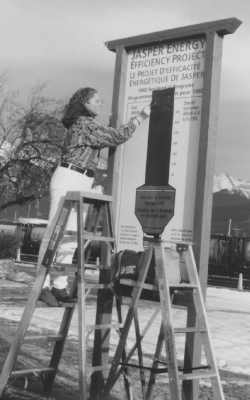
A large progress sign was placed in the centre of the town (Feedback). It tracked the total number of kilowatts of power being saved, showing the community how its participation in the JEEP program was reducing energy consumption. Feedback was also provided through newspaper articles, advertisements and the Alberta Power Smart Report.
Results
- Overall demand for power in Jasper between 1991 and 1994 was reduced by 9.6 percent, while demand elsewhere in Alberta increased by 17.5 percent.
- Reduction in residential demand for electrical energy was 490 kW, very close to the 500 kW objective.
- Alberta Power's cost for the residential portion of the JEEP program for the period between 1991 and 1992 was approximately $705 per kW saved, compared to an anticipated cost of new power generation equipment of $1,400 per kW.
- The project pay-back period was about one year, with a return on investment over a five-year period of about 95 percent per year (assuming constant savings and demand).
- The reduced demand resulted in the power plant's reducing CO 2 emissions by 730 tons and nitrogen oxide emissions by 1.5 tons.
- 38 percent of those surveyed indicated that they had undertaken additional energy efficiency measures as a result of the awareness created by JEEP.
- 34 percent of those who did not participate in the JEEP program said they did not do so because they were unaware of JEEP or did not know how to arrange for a home visit.
- A participation rate of 75 percent of residences was achieved (900 residences out of 1,200).
- 96 percent of the participants who responded to the follow-up telephone survey were "very satisfied" with the JEEP Teams' performance.
- Only 24 percent of respondents did not install their power cords, compared to the Yukon where 60 percent of the cords purchased were either not installed or installed incorrectly.
By 1995, the demand for electrical energy had returned to its 1991 level of 11.9 MW, still well below the originally projected level of 13.3 MW. Most of the increase was attributable to large growth in the commercial and industrial sectors in Jasper.
Contacts
Wilf Golbeck
ATCO Electric
P.O. Box 1450
Drumheller, Alberta
T0J 0Y0
(403) 823-1446
Fax: (403) 823-1470
Notes
Last updated: August 2004
This case study was originally published in 1998 in "Tools of Change: Proven Methods for Promoting Environmental Citizneship" by Jay Kassirer and Doug McKenzie-Mohr (Published by Canada's National Round Table on the Environment and the Economy)
Search the Case Studies
