
Tools Used
- Building Motivation Over Time
- Home Visits
- Norm Appeals
- Obtaining a Commitment
- Overcoming Specific Barriers
- Prompts
- Vivid, Personalized, Credible, Empowering Communication
Initiated By
Electricity Retailers’ Association of New Zealand (ERANZ) launched EnergyMate in collaboration with its energy retailers (Contact, Gensis, Mercury, Meridian and Nova) ) and
Partners
- Local lines companies (Alpine Energy, Firstlight Network, Network Waitaki, Top Energy, Unison, Electra, Powerco , Vector, and Wellington Electricity)
- Auckland City Council
- The Whānau Fund
- The Energy Efficiency and Conservation Authority (EECA)
Results
- Participants’ daily energy use decreased by 6.2% in the spring and by 2.3% in the summer; and increased by 3.0% in the winter and by 8.4% in the autumn. This reflected the desired pattern of use (make efficiency savings then use them to pay for more electricity in the colder months to stay warm and healthy.
- 91% of participating households reported having a better understanding of home energy and electricity use.
- Participants were in debt to their providers 20% of the time before the home visit, dropping to 13.3% after the visit. The amount of debt per bill also fell by an average of $335 per bill.
EnergyMate
Introduction
EnergyMate targeted low-income New Zealanders who were having difficulty paying their energy bills or keeping their houses warm.
The program decreased participants’ median daily energy use by 6.2% in the spring and by 2.3% in the summer; and increased use by 3.0% in the winter and by 8.4% in the autumn. This reflected the desired pattern of use wherein participants would make efficiency savings where possible, then use the savings to pay for more electricity in the colder months to stay warm and healthy.
Background
Low-income New Zealanders were suffering from poor quality housing stock, high average rents, a housing shortage, and relatively insecure tenure rights for renters. A 2018-19 Electricity Price Review brought these realities to the surface. In response, the Electricity Retailers’ Association of New Zealand (ERANZ) launched EnergyMate in collaboration with its energy retailers (Contact, Gensis, Mercury, Meridian and Nova) and local lines companies (Alpine Energy, Firstlight Network, Network Waitaki, Top Energy, Unison, Electra, Powerco , Vector, and Wellington Electricity), Auckland City Council, the Whānau Fund and the Energy Efficiency and Conservation Authority (EECA).
The program provided free in-home energy coaching for New Zealanders who had difficulty paying their energy bills or keeping their houses warm. It increased their energy efficiency knowledge and ensured they were on the most appropriate plan offered by their energy retailers. It offered tailored in-home advice, and support from trusted community members, who:
- Offered financial support, and an understanding of healthy housing and home energy use.
- Referred participants to helpful support services.
- Supported them in arranging with their electricity retailers for favorable payment plans.
EnergyMate was first pilot tested with 147 people in 2019 (Phase 1). This helped inform Phase 2 (National Roll-out), which ran between August 2020 and May 2021. Phase 3 (Māori and Pasifika Focus) ran between June and November 2021. The program was rolled out in more locations before it was concluded in December 2025.
Getting Informed
Initial interviews with low-income customers, electricity providers, and other industry experts found that these customers were generally highly cost-conscious, knew how much they spent on energy, and lived in poor-quality housing. Lack of money was the strongest barrier to making their homes more energy efficient. Other barriers included low energy and financial literacy, and low appliance efficiency.
Further, while 18% of renters in the EnergyMate program had energy efficiency issues that they needed their landlords to act on, many were reluctant to discuss with their landlords any heating problems and/or upgrades to address them, fearing their landlords might terminate their leases.
“I’m only renting, and you can only ask for so much [like a heat pump or fixing windows]; being a renter, I’ve got to be in their good books” (EnergyMate participant)
Roughly one third (31%) of participants were in debt to their electricity retailer (average debt of $444). Almost one in ten (9%) had their supply disconnected at some point within the past year. Despite all these challenges, some low-income EnergyMate participants were not comfortable using ‘energy hardship’ to describe their own situation.
Based on these research findings, the program chose to focus on building residents’ ability to manage their in-home energy use, a sphere of influence where the program would likely have the greatest impact.
Phase 1 monitoring and evaluation helped inform EnergyMate about the following.
- How the program was similar to and different from other interventions
- Its relatively limited sphere of influence
- Potential partners (e.g. HHI and Regional Public Health’s Well Homes and the 2020 Electricity Power Credit Scheme)
Prioritizing Audiences
The program targeted those living in high deprivation areas who were having difficulty paying their energy bills or keeping their houses warm. They may have experienced disconnection; the installation of pre-payment meters; credit/debt cycles; under-heating of their homes due to affordability; and/or insufficient heating.
Setting Objectives
Target behaviors include the following.- Arranging with the electricity retailer for a favorable payment plan
- Boiling less water at a time
- Fewer and/or shorter showers
- Fewer baths
- Setting the heat pump at the right temperature
- Setting the hot water at the right temperature
- Switching light bulbs to LEDs
- Switching off appliances
- Switching to cold water laundry washes
- Turning off appliances at the wall instead of leaving them on standby.
- Connecting with additional support services as appropriate (to overcome barriers and implement changes they could not achieve through energy coaching alone)
Physical home upgrades were beyond the scope of the programme. They were delivered through complementary government-funded programmes (e.g. Warmer Kiwi Homes covered insulation and heating upgrades.)
Delivery targets were set for numbers of households which engaged with the programme through in-home energy coaching.
Delivering the Program
To deliver Phase 2 of this program, ERANZ partnered with Fincap, a non-government organization supporting 200 free financial capability/ budgeting services community providers. Eight of these community providers were selected to deliver Phase 2, via 16 trained EnergyMate coaches - community-based financial mentors who received specific training for the role. Each provider was contracted to deliver EnergyMate to “up to 100 households in high deprivation areas” in their communities.
Phase 2 took place between August 2020 and May 2021 in eight areas across New Zealand. Due to COVID-19, participation was lower than expected. In all, 319 homes were visited, and eight community party/meetings (“hui”) were held.
Phase 2 delivery mechanisms included the following:
- In-home visits (Home Visits) to:
- Review home energy efficiency (Vivid, Personalized, Credible, Empowering Communication.)
- Co-create an action plan to reduce non-essential power usage (Building Motivation Over Time; Obtaining a Commitment. For example, turning off appliances at the wall instead of leaving them on standby could result in saving $100 a year. Other common tips included the following: switching off appliances; boiling less water at a time; setting the heat pump at the right temperature; setting the hot water at the right temperature; switching light bulbs to LEDs; fewer baths; fewer and/or shorter showers; and switching to cold water laundry washes).
- Connect with electricity retailers to understand plans and payment options (three-way call.)
- Connect with additional support services as appropriate.
- Follow up after eight weeks to check progress. (Building Motivation Over Time; Obtaining a Commitment; Prompts)
- Community parties/meetings (hui) that raised energy efficiency knowledge and provided hands-on learning about how to save energy, read power bills, and get the most suitable power plan. (Norm Appeals; Vivid, Personalized, Credible, Empowering Communication)
- Light-hearted animated shorts featuring money-saving tips delivered by animated caricatures, using the voices of actual EnergyMate coaches. (Vivid, Personalized, Credible, Empowering Communication)
Community providers were contracted to:
- Drive program referrals from local retailers, other local partners, and their own client bases.
- Visit participants’ homes to coach them through an initial home assessment, paperwork, follow-up visits, and regular reporting to ERANZ using an online data platform.
- Refer residents to additional support services as appropriate.
In addition, energy hardship training was provided for social service providers working with those at risk of energy hardship.
Typically, participants had already been identified as being in high need and would have already received interventions like heating, insulation and curtains. However, most had not previously had tailored home energy efficiency support. Participants gave informed consent to participate and share energy consumption data with ERANZ.
For Phase 2 a total of eight community hui were held in seven regions, reaching at least 172 attendees. They communicated key messages in a lively and engaging manner, using games, quizzes, brochures, and prizes such as LED lightbulbs/electric heaters). Two of the aspects of the hui most appreciated by participants were hearing from a number of retailer representatives and being able to ask them questions, and the combination of budgeting advice with energy advice. More hui were delivered in later phases./p> Addressing Key Barriers
The following table shows the key barriers to action and how they were addressed (Overcoming Specific Barriers).
|
Barrier |
How it was addressed |
|
Lack of money to pay for improvements Lack of recognition of their own energy hardship |
· The coaching service was offered free, many recommendations were cost-free, and 37% of participants were referred to additional support services (such as the Healthy Homes Initiative and curtain banks) that subsidized improvements to their houses and appliances. · Energy hardship training for social service providers working with those at risk of energy hardship. |
|
Low energy and financial literacy |
· Focused on building residents’ ability to manage their in-home energy use. · Co-created an action plan to reduce non-essential power usage. · Connected households with their electricity retailers to understand plans and payment options (three-way call.) · Connected them with additional support services as appropriate. · Community hui raised energy efficiency knowledge and provided hands-on learning about how to save energy, read power bills, and get the most suitable power plan. |
|
Low appliance efficiency |
· Several common action plan recommendations reduced appliance use. · 37% of participants were referred to additional support services (such as the Healthy Homes Initiative and curtain banks) that subsidized improvements to their appliances. |
|
Forgetting to act, Inertia |
· Followed up after eight weeks to check progress. |
Measuring Achievements
The following data sources were used in evaluating the program.
- Monthly Electricity bill data from Phase 1 (n=51 participants) for the 12 months before and after the home visit provided information on energy use, payments, debts, and disconnections.
- Project delivery data and monitoring information (Phase 2)
- Participants’ home energy profiles (n=319)
- Both quantitative and qualitative information from a check sheet that was filled in by the coaches during home visits (n=319)
- Participant surveys eight weeks after the follow up visits (n=226.)
- In-depth participant interviews (n=7; six by telephone and one in person) explored experiences of the program and energy hardship, enablers of action, and barriers to action. Community providers helped select the participants, introduced the evaluation to them, and established trust. Each participant was paid 40 koha.
- Expert interviews (n=5)
- Interviews with EnergyMate providers (n=2)
- Survey of participating electricity retailers (n=7) asking credit managers their views on EnergyMate delivery and outcomes for both retailers and customers.
- One community hui observation on May 14, 2021, attended by 42 participants, one electricity retailer and two community providers.
A Provider Workshop, held on June 11, 2021, focused on shared learnings, what had gone well and why. It also assessed outcomes for participants and providers.
Financing the Program
EnergyMate was primarily funded through electricity retailers, with funds held and governed by ERGANZ, which also absorbed some programme administration and oversight costs. Additional funding was provided by the government through the SEEC Programme, as well as regional lines companies. Government support played a critical role in both enabling programme delivery and reinforcing EnergyMate’s credibility and impact in helping whānau achieve warmer, healthier, and more energy-efficient homes.
Results
Reach
- Between 2019 and 2025, EnergyMate helped 3,524 households in locations across New Zealand. This includes participants in Phases 1 to 3, plus more recent participants.
Uptake and Energy Literacy
- 91% of participants reported having a better understanding of home energy and electricity use since the EnergyMate visit.
- 91% completed at least some the energy efficiency actions recommended by their energy coaches.
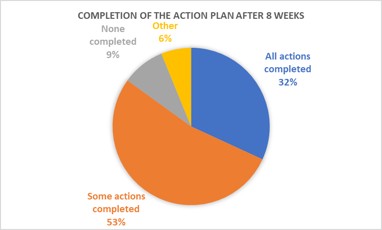
Completion of action plans after 8 weeks (n=226) from Phase 2 Evaluation Report
- Post-visit data (after eight weeks, then six months) indicate high retention of energy-use knowledge and efficiency behaviors.
Reduced Energy Poverty
- Monthly Electricity Bill Data showed that median daily energy use decreased by 6.2% in the spring and by 2.3% in the summer; and increased by 3.0% in the winter and by 8.4% in the autumn. This reflected the desired pattern of use wherein participants would make efficiency savings where possible, then use the savings to pay for more electricity in the colder months to stay warm and healthy.
- The billing data also showed that participants were in debt to their providers 20% of the time before the home visit, dropping to 13.3% after the visit. The amount of the debt per bill also fell by an average of $335 per bill, representing $1,180,540 across 3,524 households.
- 18% of households were on the wrong plan (low fixed charge versus standard) before an EnergyMate visit. After the visit this fell to 8%.
Successful Referrals to Additional Support Services to Tackle Energy Hardship
- Over 60% of participants were referred to additional services
- Budget services (22%)
- Healthy Homes (11%)
- Curtain banks (13%)
- Most referrals had been actioned within eight weeks (55%)
Arranging with the Electricity Retailers for a Favorable Payment Plan
- Most participants (85%) were already on the best tariff for their circumstances. In total, 11% switched to a new power plan and 6% moved onto a new/updated payment option such as SmoothPay. According to the coaches, the three-way call resulted in stopped disconnections, bill corrections and refunds.
- Overall, retailers valued the program, and many agreed that it should be expanded to cover more areas nationally.
Lessons Learned
- Residents experiencing energy poverty can benefit from energy efficiency programs specifically targeted at them.
- Many may not be on the best energy plans for them, which may be unnecessarily adding to their energy costs. A successful way to address that is to arrange three-way phone calls to their energy providers, having both the resident and the advisor on the line when calling the energy provider.
Notes
- Program impacts went beyond energy use, to include improved energy literacy and reduced energy poverty.
- A similar approach could be used for people having trouble affording food, water, clothing or transit rides.
More Information
EnergyMate Phase 2 Evaluation Report: www.eranz.org.nz/assets/documents/EnergyMate+Phase+2+Evaluation+Report+10+Sept+2021.pdf
Contact
Electricity Retailers’ & Generators’ Association, New Zealand: admin@erganz.org.nz
Case Study Development Credits
This case study was was written by Jay Kassirer in 2026 based on the Phase 2 evaluation report (linked to in the section “More Information” above) and review comments from Miranda Struthers, Accessible Energy Advocate for the Electricity Retailers’ and Generators' Association, New Zealand.
Search the Case Studies
